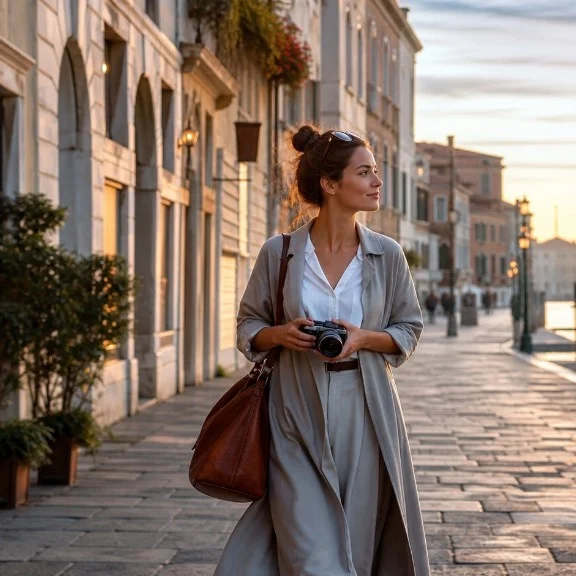
Venice can be seen in two to three days, and the only rule that matters is to get off the St Mark's-Rialto axis, where eighty percent of visitors concentrate and one hundred percent of the traps lie. From Montreal, a direct flight connects Trudeau to Marco Polo Airport, making it one of only three Italian cities accessible without a connection. The city now charges a day-visitor access fee on certain high-traffic dates, which should be checked before you leave. The best window runs from April to June, then September to October.
In this article you will learn where to stay, what is actually worth the detour, how to avoid the pitfalls, and what a traveler from Quebec needs to plan for.
Why Venice
Nothing like it exists anywhere else in the world. A city without cars, built on water, whose map has not fundamentally changed in centuries. This is not guidebook hyperbole; it is an urban-planning fact.
What it is not, and this needs to be said plainly. Venice is not restful during the day. The center is saturated, prices are inflated, and mass tourism has turned part of the city into a stage set. Many visitors leave disappointed, because all they saw was the St Mark's-Rialto axis.
Venice reveals itself early in the morning, late at night, and in the neighborhoods where no one goes. Accept that and you leave marked by it. Stay on the main axis and you leave wondering what the fuss was about.
Getting there from Quebec
The flight. A direct flight connects Montreal-Trudeau to Venice's Marco Polo Airport. This is a significant advantage — Venice is one of only three Italian destinations reachable without a connection from Montreal, along with Rome and Milan. Availability varies by season; check before building your itinerary.
From the airport to the city. Several options, and the choice matters.
- The bus to Piazzale Roma, the land gateway to Venice. Economical and reliable.
- The boat, the Alilaguna, slower but it brings you in by water, which is infinitely more beautiful.
- The private water taxi, fast and expensive.
One practical note. Once in Venice, there are no cars, no land taxis, and no smooth-rolling suitcase wheels. You will carry your luggage over bridges. Travel light — this is not a style tip, it is a back-health issue.
Jet lag. Six hours ahead of Quebec. The first day is largely unproductive.
The access fee
Venice has introduced a day-visitor access fee, applicable on certain high-traffic dates. People staying overnight in the city are generally exempt, but must still complete a registration step.
The rules, dates, and amounts change over time. Check the current situation on the city's official website before you leave. This is not a minor detail — the absence of valid documentation can result in a fine during a spot check.
It is also one more argument in favor of a two- or three-night stay rather than a quick day trip.
When to go
| Period | Weather | Crowds | Note for Quebec travelers |
|---|---|---|---|
| March, spring break | Cool, damp | Moderate | Affordable, but fog risk |
| April to June | Mild | High | The best window |
| July and August | Hot, heavy | Peak | Construction vacation season, therefore the worst time. Muggy heat, smelly canals |
| September and October | Mild | Declining | Excellent compromise |
| November to February | Cold, misty | Low | Venice in the mist is beautiful, but acqua alta risk |
| Carnival, February | Cold | Very high | Spectacular, but extreme prices and crowds |
Acqua alta. High tides periodically flood the lower-lying areas, including St Mark's Square, mainly from autumn through early spring. It is not a disaster — the city keeps functioning with raised walkways — but bring rubber boots or waterproof shoe covers if you visit during this season.
Where to stay
The choice of neighborhood shapes your experience of Venice more than any other factor.
Avoid. The immediate surroundings of St Mark's Square. Expensive, noisy, and entirely oriented toward through-traffic.
Cannaregio. The best compromise. Residential and lively, with real grocery stores and real residents. The old Jewish ghetto is located here.
Dorsoduro. A student and arts neighborhood, home to the Peggy Guggenheim Collection. Pleasant and less expensive.
Castello. Large, quiet once you move away from the main routes, and very authentic in its eastern parts.
On the mainland, in Mestre. Considerably cheaper, but you lose Venice in the evening and the morning — the only two times it is truly itself. A false economy in most cases.
What to see, and what is overrated
Must-dos
- St Mark's Basilica, with its golden mosaics. Book ahead to skip the line.
- The Doge's Palace, and the Bridge of Sighs seen from inside.
- Getting deliberately lost, in Cannaregio or Castello. It is the best activity in Venice and it is free.
- A vaporetto on the Grand Canal, line 1, end to end. It is the most beautiful avenue in the world for the price of a transit ticket.
- Torcello and Burano, in the lagoon. Burano for its colorful houses, Torcello for its mosaics and silence.
What often disappoints
- The gondola. Expensive, short, and you share the canal with ten other gondolas. It is not a scam, but the value-for-money ratio is low. The vaporetto offers more of Venice for far less.
- Murano. Glassware is sold everywhere there, much of it imported. The demonstrations are often tourist traps.
- Restaurants with a tourist menu. Consistently poor.
How many days
Two days. The minimum, and already enough for Venice, which is small.
Three days. The right format. You add the lagoon, Burano, and Torcello, and give yourself one unscheduled morning.
More than four days. Rarely necessary, unless you are combining with the Veneto, Verona, or Padua.
Venice pairs well with Lake Como, connected by a direct train.
Budget
Venice is the most expensive Italian city, without question.
- Accommodation. The biggest expense, and the gap between the center and Cannaregio is considerable.
- Food. The main trap. A coffee taken seated at St Mark's Square costs several times the going rate. Move three streets away and prices return to normal. The coperto, the per-person cover charge, is legal but must be displayed.
- Transport. Vaporetto tickets are expensive individually. A multi-day pass quickly pays for itself.
- The access fee, where applicable.
Getting married in Venice
Venice is a spectacular wedding destination, and a logistically demanding one.
The constraint is physical. No cars, so transfers between the church and the reception venue take place by boat. This adds a cost item and a level of complexity that other destinations do not have.
For a Catholic wedding, the rules are the same throughout Italy. The consent of the priest of the chosen church must be obtained before any booking. The canonical file is prepared in your home parish and passes through two diocesan chanceries. Twelve months minimum.
Search volume for a wedding in Venice remains low in the French-speaking market, but the destination exists and it is a credible choice.
The procedures are detailed in getting married in a Catholic church in Italy, and the documents in papers for a religious marriage abroad.
To review your file, get in touch.
Mistakes to avoid
- Coming on a day trip. You will only see the crowds. Venice begins when the cruise passengers leave.
- Staying on the St Mark's-Rialto axis. Eighty percent of the visitors, one hundred percent of the traps.
- Traveling with large suitcases. You will carry them over bridges, by hand.
- Eating with a view of a famous canal. The price doubles, the quality drops.
- Ignoring the access fee. Check before you leave — a fine is possible.
- Staying in Mestre to save money. You lose the morning and the evening, the only two good moments.
Conclusion
Venice disappoints those who pass through it and marks those who sleep in it. It is as simple as that.
Two or three nights, a residential neighborhood, mornings before eight o'clock and evenings after the visitor tide has receded. On those terms, it delivers on every promise.
For other regions, see Rome and Tuscany, or all destinations.
Frequently asked questions
- Is there a direct flight from Montreal to Venice?
- Yes, a direct flight connects Montreal-Trudeau to Marco Polo Airport. Venice is one of only three Italian destinations reachable without a connection from Montreal, along with Rome and Milan. Availability varies by season and by year; check before building your itinerary.
- Do you have to pay a fee to enter Venice?
- A day-visitor access fee applies on certain high-traffic dates. People staying overnight in the city are generally exempt but must register. The rules and dates change; check the city's official website before you leave, as a fine is possible if you are stopped without documentation.
- How many days do you need to visit Venice?
- Two days cover the essentials, and three is the right format once you add the lagoon, Burano, and Torcello. The city is small and entirely walkable. Beyond four days, it is better to combine the stay with the Veneto, Verona, or Padua, or move on to another region.
- Is a gondola ride worth the price?
- The value-for-money ratio is low. The ride is short, expensive, and the canal is shared with other gondolas. It is not a scam, but the line-1 vaporetto, which travels the full length of the Grand Canal, offers more of Venice for the price of an ordinary transit ticket.