Getting married at St. Peter's Basilica is possible, but strictly framed. At least one spouse must be a baptized Catholic, the canonical file goes through your home diocese, and the ceremony takes place in the Choir Chapel, reserved for Catholic rites, with a file submitted several months ahead.
Dreaming of marrying at St. Peter's Basilica, in the heart of the Vatican, raises a very concrete question at once: is it truly accessible to an ordinary couple, or only to a privileged few? The honest answer sits between the two. The place is not closed to believing members of the public, but it is nothing like a venue you book online as you would a restaurant.
Many Quebec couples discover the topic with expectations shaped by spectacular photos, without knowing what the place actually allows. This article sorts fact from myth, step by step, so the project rests on facts rather than impressions.
Is it really possible to marry at St. Peter's Basilica?
Yes, it is possible, and that deserves to be said clearly, because the opposite myth circulates widely. The parish office of St. Peter's Basilica confirms on its official site that a wedding can be celebrated there and invites couples to write directly to arrange the steps.
What makes the project demanding is therefore not a ban, but a framework. The basilica remains first and foremost a major place of worship, visited by thousands of people every day. A ceremony cannot disrupt that balance, which explains precise rules about timing, the exact location, and the profile of the couple.
It is also important to distinguish two realities that are often confused. Physically marrying in the basilica is not the same as obtaining a papal blessing or a Mass celebrated by a cardinal. The realistic project aims at a dignified Catholic celebration in a dedicated space, not a media event.
Religious conditions to meet first
The very first condition is neither logistical nor financial: it is spiritual. The marriage celebrated here is a Catholic sacrament, not a simple service. That shapes the rest of the file.
Here are the basic prerequisites couples generally need to meet:
- At least one of the two spouses must be a baptized and practising Catholic
- The fiancés must be free of any previous marriage bond recognized by the Church
- Marriage preparation (the equivalent of prenuptial courses) must be completed in the home parish
- The pastor of that parish must attest that the couple is active and in good faith
These requirements are not decorative formalities. They condition acceptance of the file long before it reaches Rome. A couple with no parish connection will struggle to obtain the letter of recommendation that opens the rest of the process.
The canonical file and required documents
The heart of the project is the canonical paperwork, assembled in the home diocese and then forwarded to the Vatican. Nothing is settled by a last-minute email. Documentary rigor is part of the process itself.
The file usually includes baptism and confirmation certificates, the prenuptial inquiry, the declaration of freedom to marry, and the Nulla Osta signed by the pastor or the bishop. A letter of introduction from the local bishop, addressed to the Vicariate of Vatican City, generally completes the set.
Each document must be recent, often less than six months old, and translated when needed. A single missing piece can suspend the entire timeline. This is precisely where advance preparation makes the difference between a project that succeeds and a dream that stalls.
A well-informed couple also prepares the civil transcription of the marriage on return — a track distinct from the religious one. Structured accompaniment from the start avoids file errors that push a date back. Plan your project with people who know the canonical process in Italy to save precious time.
The Choir Chapel: the only place for the ceremony
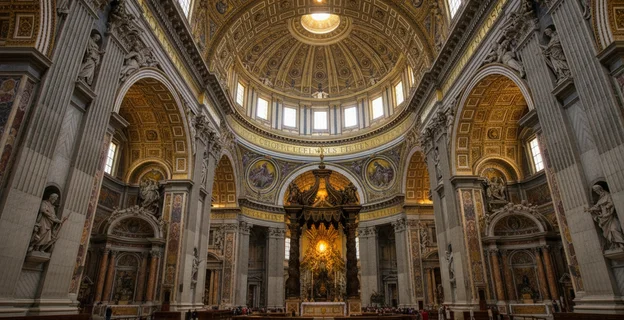
Contrary to the widespread image of a wedding under the great dome, the celebration is not held in the centre of the basilica. It takes place in the Choir Chapel, a splendid but intimate side space, away from the flow of visitors.
That choice has very concrete consequences for planning. Capacity is limited, often around thirty guests. It is therefore not a large gathering but a collected ceremony, which many couples seeking authenticity actually prefer.
A few practical rules also frame the day:
- Only Catholic rites are allowed in this space
- Modest dress is expected, with shoulders covered for everyone
- Slots are generally on weekdays, in the morning, outside major services
- Punctuality is strict: Vatican schedules tolerate no delay
Understanding this framework prevents false expectations. The beauty of the place is not negotiable, but it comes with a discipline the couple accepts in advance.
How much time to allow, and what budget to anticipate
Time is the most underestimated resource in this kind of project. Places are scarce and validations are long. Starting the process too late remains the first cause of disappointment.
Serious guides recommend beginning preparation six to twelve months before the date, and submitting the complete file at least three to six months ahead. Those windows exist to validate each document and secure a slot.
On the budget side, amounts vary widely depending on church fees, administrative accompaniment, translations, and especially travel logistics. It is wiser to build a personalized estimate than to rely on a single figure seen elsewhere.
Alternatives among Rome's basilicas
St. Peter's Basilica is not the only option for a memorable Catholic wedding in Rome. When the Vatican file proves too tight on timing, other places offer comparable majesty with sometimes more flexible rules.
Several Roman basilicas and churches host magnificent celebrations, each with its own architectural character and atmosphere. Exploring those options keeps the spirit of the project — a sacred marriage at the heart of Catholic history — even if the address changes. To compare possibilities, see also organizing a Catholic wedding in Rome.
Conclusion
Marrying at St. Peter's Basilica is a real project, provided you treat it as a demanding religious process and not a simple booking. The key rests on three elements: Catholic eligibility, an impeccable canonical file, and a timeline started very early. The intimate ceremony unfolds in the Choir Chapel, making it a collected moment rather than a spectacle.
A well-prepared couple turns an administrative constraint into a deeply memorable experience. To move forward calmly, have your situation reviewed before locking anything in.
Frequently asked questions
- Can you really marry at St. Peter’s Basilica without living in Rome?
- Yes. Marrying at St. Peter's Basilica remains open to foreign couples, including from Quebec, without residence in Rome. The central condition is religious: at least one spouse must be a baptized Catholic and present a complete canonical file assembled in their home diocese. The Vatican parish office then validates each request, which is why a comfortable preparation lead time is strongly recommended.
- What documents are required for a Vatican wedding?
- The file rests on the usual canonical pieces: baptism and confirmation certificates, the prenuptial inquiry, the declaration of freedom to marry, and the Nulla Osta signed by the pastor or bishop. A letter of introduction from the local bishop, addressed to the Vicariate of Vatican City, generally accompanies the request. Each document must be recent, translated when needed, and submitted within the deadlines set by the office concerned, without exception.
- In which part of the basilica does the ceremony take place?
- Weddings take place in the Choir Chapel, a side space of the basilica, not under the great nave open to visitors. Capacity remains limited, often around thirty guests, which favours an intimate celebration rather than a large gathering. Only Catholic rites are allowed there, and modest dress with covered shoulders is expected of everyone present that day.
- How far ahead should you start the process?
- Preparation ideally spans several months, often six to twelve months before the desired date. The complete canonical file should then reach the relevant authorities at least three to six months ahead. Those timelines exist to validate each document, obtain authorizations, and reserve a slot, since places remain scarce. Starting early is the best way to secure a precise date without stress.